
Aggregation and agglomeration
Connect electrokinetic evidence to observed particle association.
A condition-controlled guide to using zeta potential as one part of a silica dispersion stability assessment.
Zeta potential can support comparison of colloidal stability, but the result depends on the dispersion medium, pH, ionic strength, temperature, surface chemistry, concentration and measurement model.
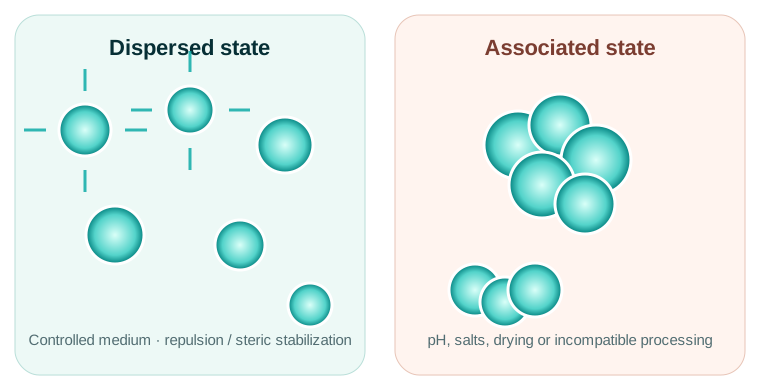
Electrostatic or steric interactions can reduce particle-particle association when the formulation and conditions are controlled.
| Question | Why it matters | Record with the result |
|---|---|---|
| What medium? | Controls dielectric properties, viscosity and ion environment | Exact dispersant and composition |
| What pH and conductivity? | Strongly influence surface ionization and double-layer behavior | Measured pH, conductivity and preparation |
| What surface? | Native silanol, amine, hydrophobic and polymer coatings behave differently | Surface treatment and lot |
| What temperature? | Affects viscosity and electrokinetic calculations | Measurement temperature |
| What model and instrument? | Conversion from mobility to zeta potential uses assumptions | Instrument, cell, model and settings |
NIST and collaborating organizations have developed certified reference materials for zeta potential in defined colloidal systems. The value of that work is not a universal “good” zeta potential. It is the ability to evaluate measurement performance under controlled conditions.
It can indicate stronger electrostatic repulsion under the measured conditions, but steric stabilization, pH, ionic strength, concentration and surface chemistry also matter.
Only with adequate method and condition control. Temperature, dispersant, conductivity, pH, model and instrument settings can change the result.
It is an electrokinetic potential associated with the slipping plane, not a direct universal measurement of intrinsic surface charge.
Commercial specifications should be confirmed against the current Applied Physics quotation, certificate, lot documentation and product page before purchase or protocol use.
Connect electrokinetic evidence to observed particle association.
Compare medium-dependent stability requirements.
Control the user steps most likely to change stability.
Send the target size, medium, concentration, application, certificate requirements and shipping destination. Applied Physics can evaluate the appropriate silica family or custom pathway.